

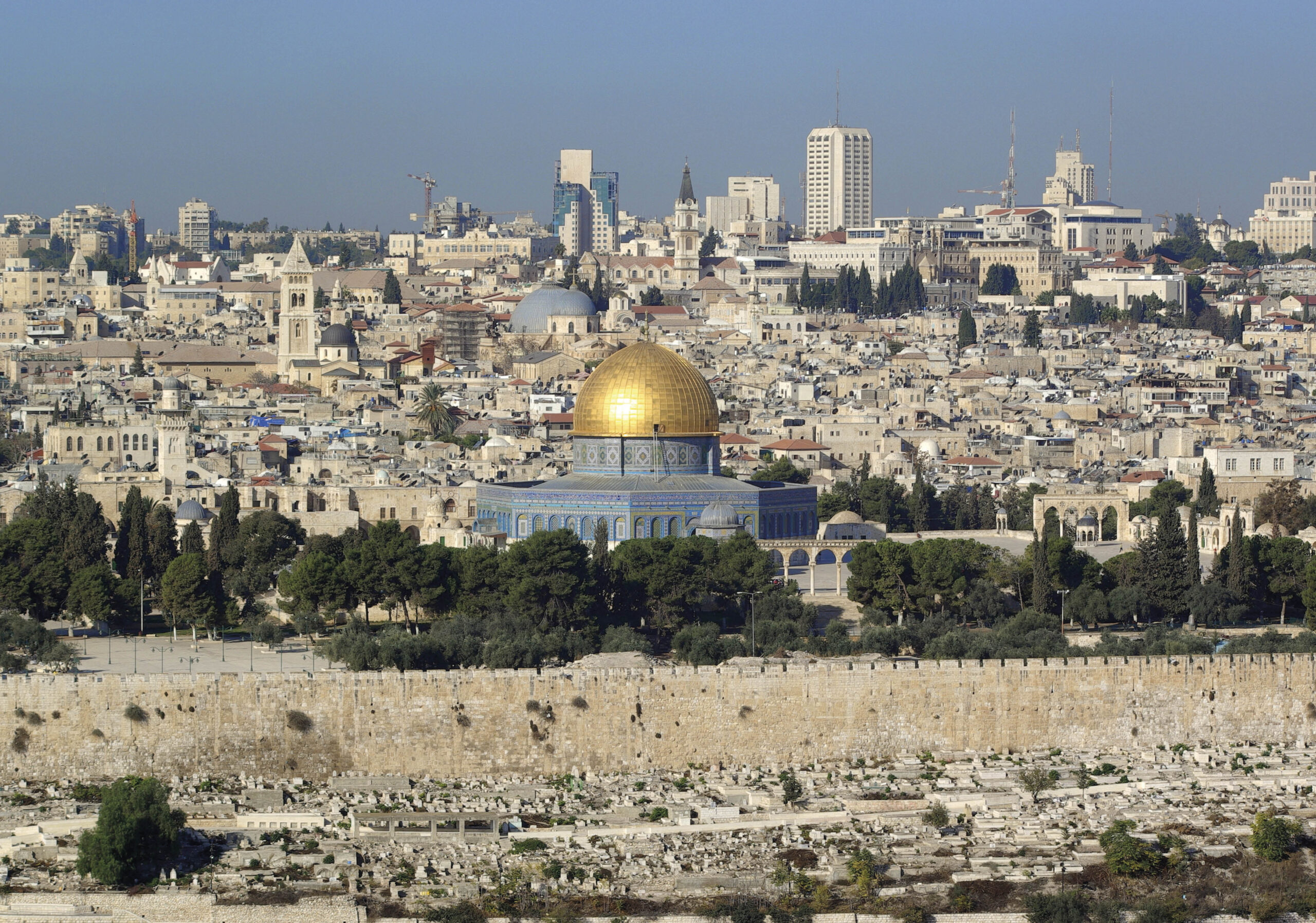
Although also for West Jerusalem they believe in and worship in East Jerusalem in the beating ancient heart of the (Eastern) Old City. Geographically the Palestinian parts of Jerusalem are the centre, as well as to the East and the North, but now these are ringed round by massive Israeli suburbs dominating the hilltops; the so called “settlements”. The centre is the walled city, and the areas surrounding this, but it is not surrounded with settlements; instead there are increasing numbers of settlers taking over and living in its midst. So am I at the centre of the world? I live in East Jerusalem, only a twenty minute walk from the centre of the Old City, from the religious sites which are now void and vibrating with the tension of emptiness; silenced by the noise of the coronavirus pandemic. But I also live right on the edge; my garden borders the now full (formerly empty) space of the no-man’s land that marks the division between Israel and Jordan from 1948-1967. This house is built on the edge — outside the old walled city — but at the centre of the war on the front line — is that too a centre? This edge is there in me too, as an outsider (from Britain, perfidious Albion, author of the infamous Balfour Declaration) and also an insider — right at the centre through my marriage to an intellectual and activist from one of the oldest and most distinguished Palestinian families in Jerusalem. What is a suburb or a periphery in this case? When the levels of complexity are such that there are layers even in the centrality – perhaps a true “sub”urbs. Since the annexation of East Jerusalem by the Israelis in 1980 (de jure, and de facto since 1967) Palestinians have been reduced to the status of “permanent residents”, subject (thrown under?) to Israeli laws, who have to prove regularly that Jerusalem is their “centre of life”, via electricity bills, property taxes, school bills etc. and that they are not living out in the suburbs (wild sub standard?) of the West Bank. If they fail to prove this — and there are some 3,000 Palestinians every year who have failed since 1967 — they risk not only losing their right to live in Jerusalem but even their right to visit without a permit; which they may or may not be granted. They risk being permanently severed from the centre. Some live in the suburbs and pay bills on behalf of others, some move into crowded inadequate housing just to maintain their Jerusalem address, and some apply for Israeli citizenship, splitting their identity down the middle, or handing it over completely to the dominant Israelis. Who is marginal and who is central here?
A “suburb”, the “suburbs”; these to me conjure up images of far bigger cities than Jerusalem, where we still mostly have villages that have spread, rather than growths that have emerged as extensions of the city — the spacious or crowded suburbs of America or Mumbai city. Who wants to be “suburban” going underneath the city centre, lower in every sense? But under the city of Jerusalem there are other older cities, a vast complex of caverns and tunnels; roads, houses, cisterns – a whole underground water system, from when it was on the periphery of the Roman Empire and even earlier, in multiple layers. But as these “subcities” are excavated they threaten the living above them; causing subsidence and collapse in the streets of the Old City. The fear is constantly voiced that the excavations will cause the Aqsa Mosque or the Dome of the Rock to collapse, opening up the contested centre to the cupidity and dreams of the settler extremists who would like to tear down the Moslem monuments and replace them. Here the suburbs have to be (and must remain?) underneath, since there is not the luxury of space. The dream is of “a Palestinian state with East Jerusalem as its capital” but in the mis-named “peace processes” what is proposed as “East Jerusalem” is not the centre, or even the city, but the villages to the North or to the East, such as Shu’fat (complete with its own teeming refugee camp) or Abu Dis, where the eastern desert starts its stretch all the way to Mesopotamia; already when it was a mere seven minute drive from the Old City it was seen as “the end of the world”; now it is more than an hour away, severed from the city by the wall. Beit Hanina, Shufat, Ram (where the Palestinians from the historic “Moroccan quarter” at the epicentre of the Old City next to the Western Wall were moved to, when it was demolished in June 1967 -which is excluded, crime-ridden and surrounded by Israeli walls on three sides) Abu Dis – as Palestinians are pushed to these suburbs, can they ever by pulled into being “real centres”?
For the Israelis, Jerusalem is one united city and must remain that way.
The borderlines are in the mind — the barriers between the Occupied West Bank and Annexed East Jerusalem are often highly visible as photogenic concrete walls, but the barriers between East and West Jerusalem are there in the faces, in the expressions, in the interactions. As the numbers of cases of the COVID-19 were published every day, East Jerusalem was counted twice — as part of Israel and as part of the West Bank. There were thousands more cases in Israel than in the West Bank, which had only a few hundred well traced and controlled cases. East Jerusalemites were barred from the West Bank as potential bringers of disease. The East Jerusalem hospitals, underfunded and underequipped but still better than any in the West Bank, were helped to prepare themselves. Local Palestinian community groups became energised and started to set up tents and even testing centres, but these were torn down by the Israeli authorities, allegedly angry that the Palestinian Authority was taking action in Jerusalem, where Israel has to be the one and only central authority. Cooperation between Israelis and Palestinians was exemplary at the highest levels during the height of the pandemic and lockdown, and the many Palestinians in the health services, doctors, nurses, from the West Bank, from inside Israel, from East Jerusalem, were seen with new eyes by the Israeli public, as they saved lives and showed their courage on the front lines … – as humans who could be relied on to help. This was the view at the centre and under the lockdown. But on the outskirts of the perceptions, beyond the view and the interests of many, the daily abuses and injustices of the occupation continued and continue; there has been no lockdown of occupation and all it entails. The settler attacks on farmers and their olive trees and flocks; the nighttime incursions into Palestinian homes to arrest young men; the destruction of a hospital tent in a remote village in the Jordan valley, the relentless sub actions against sub human beings, wearing down the Palestinians, pushing them always away from any form of power or of peace. Jerusalem used to be the centre, the hub for all Palestinians, but since the walls have gone up around it and the permit system has made access for (non-Jerusalemite) Palestinians almost impossible — all of these on the grounds of “security”, it has been isolated and drained of life and culture. Children play truant from school and leave early to work and earn good money in the Israeli system in construction or supermarkets rather than continue their education towards empty prospects. Leaving their historic centre to work under the current centre of power. And I am here in in the middle of all of this — my own place — held in place by my family by the history of the city, by the multiple human needs and confusions, including the confused perceptions; looking for humanity wherever — in refugee camps on the outskirts, among the fragmented and frustrated, the Palestinians who are denied the central fundamental right of being human. In East Jerusalem, in all parts of Jerusalem, the human being is the centre.
PLEASE NOTE
Italian version here.